Cyber Incident Response Guide for SMBs
- John W. Harmon, PhD

- 19 hours ago
- 6 min read
A ransomware alert at 2:13 a.m. does not leave much room for debate. The real question is whether your team already knows who takes charge, what gets isolated first, how evidence is preserved, and when customers, regulators, or contract partners need to be notified. That is where a cyber incident response guide matters - not as shelf documentation, but as an operating plan for reducing downtime, limiting damage, and protecting trust.
For small to mid-sized businesses, local governments, and compliance-driven organizations, incident response is not only a security issue. It is an uptime issue, a contractual issue, and often a leadership issue. If your environment supports public services, financial operations, regulated data, or defense-related work, a slow or improvised response can create consequences well beyond the initial compromise.
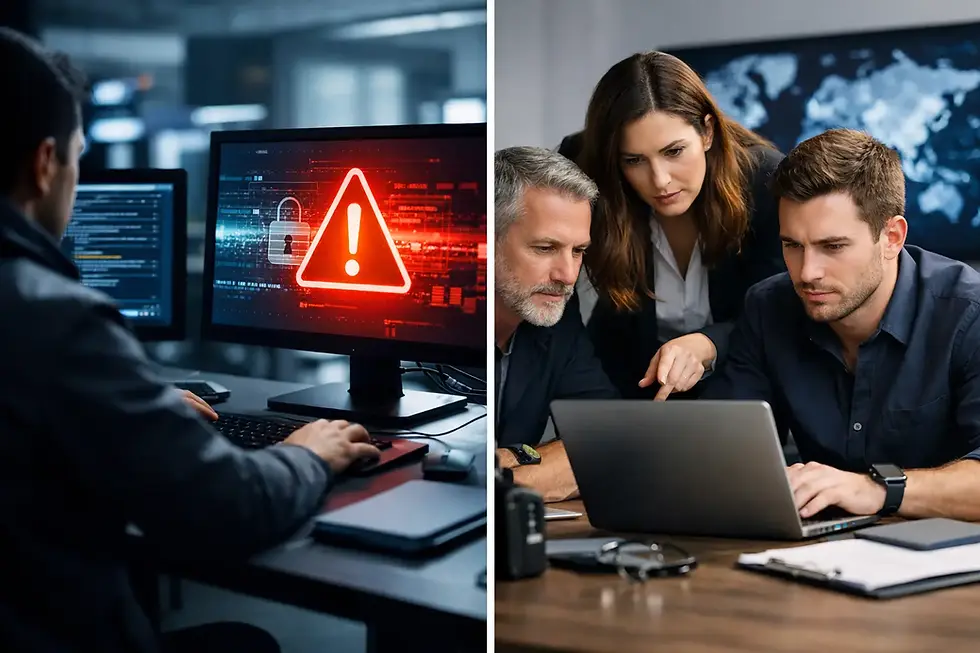
What a cyber incident response guide should actually do
A useful plan should help your organization make sound decisions under pressure. It should define roles, escalation paths, technical actions, communication requirements, and recovery priorities in language your team can act on quickly. If the document reads like policy but cannot support a 3:00 a.m. containment decision, it is incomplete.
This is where many organizations get exposed. They may have security tools, backups, and cyber insurance, yet still lack a practical response structure. The gap usually appears in the first hour of an incident, when teams are deciding whether to disconnect systems, whether the issue is isolated or spreading, and whether they have enough evidence to understand what happened.
A good guide also recognizes that incidents vary. A stolen user credential, a business email compromise, an active ransomware event, and suspicious outbound traffic from a server do not all require the same first move. Speed matters, but the right speed matters more.
The core phases of incident response
Most effective response programs follow a clear sequence: preparation, identification, containment, eradication, recovery, and lessons learned. Those labels are familiar for a reason, but the value comes from how they are applied in your environment.
Preparation sets the pace for everything else
Preparation is where response either becomes manageable or chaotic. This phase includes asset inventories, endpoint visibility, log collection, backup validation, privileged access controls, escalation contacts, and documented responsibilities. It should also define which systems are mission-critical, which data sets are regulated, and what recovery time expectations leadership has approved.
For organizations working against NIST, CMMC, DFARS, or similar requirements, preparation should also account for evidence handling, reporting obligations, and chain-of-custody expectations. If those details are not established ahead of time, technical teams can end up solving one problem while creating another.
Identification requires evidence, not guesswork
An incident starts with a signal, not always with certainty. That signal might be repeated failed logins, endpoint detection alerts, unusual PowerShell execution, unauthorized account changes, suspicious firewall activity, or reports from users who cannot access files.
The goal here is to quickly determine whether the activity is malicious, accidental, or benign. False alarms happen. So do slow-moving intrusions that look harmless at first. The difference comes down to monitoring coverage, log quality, and experience interpreting what the data actually means.
Containment should protect operations while limiting spread
Containment is often the most time-sensitive stage. The right action may be isolating a workstation, disabling a compromised account, segmenting a server, blocking outbound traffic, or temporarily restricting remote access. The trade-off is that aggressive containment can also disrupt business operations.
That is why your guide should separate emergency containment from strategic containment. An infected endpoint may need immediate isolation. A production system supporting a critical workflow may require a more controlled approach, especially if taking it offline would stop service delivery or interrupt a regulated process.
Eradication removes the cause, not just the symptom
Once the threat is contained, the focus shifts to root cause. Was it a vulnerable internet-facing service, a phishing email, reused credentials, an unpatched application, an open port, or a misconfiguration that allowed lateral movement? If you skip this work, the incident can return through the same path.
Eradication may involve deleting malicious files, removing persistence mechanisms, resetting credentials, rebuilding compromised devices, patching software, tightening firewall rules, and reviewing privileged access. This step should be documented carefully, especially if your organization may need to demonstrate due diligence to customers, auditors, or contracting authorities.
Recovery is about safe restoration, not fast restoration alone
Recovery means restoring systems to normal operation with confidence that they are no longer compromised. That can include restoring from backup, validating system integrity, monitoring for reinfection, and confirming that core services are stable before declaring the incident closed.
Backups matter here, but backup existence is not the same as backup readiness. If recovery points are outdated, untested, or reachable from the same compromised credentials, your recovery strategy may fail when you need it most. Resilience depends on tested recovery procedures, off-site protection, and a realistic understanding of what can be restored within your required timeline.
Cyber incident response guide: the roles your team needs
The most common response failure is not a missing tool. It is uncertainty about ownership. Every incident response guide should identify who leads the response, who approves major containment actions, who manages internal communications, who handles outside notifications, and who documents decisions.
For many organizations, that team includes executive leadership, IT operations, security support, legal or compliance stakeholders, and communications personnel. Smaller organizations may not have all of those roles in-house, which makes a managed partner especially valuable. External support can provide 24/7 monitoring, escalation discipline, and technical depth without forcing internal teams to build enterprise-scale coverage on their own.
The right structure also depends on your environment. If your organization supports public systems, protected information, or government contracts, the compliance function should not be treated as an afterthought. Notification thresholds, evidence preservation, and incident categorization should be aligned before an event occurs.
What to document before an incident happens
A practical guide should include current contact lists, escalation timelines, critical asset inventories, data classifications, backup locations, access to logging systems, and authority for emergency changes. It should also define how incidents are classified by severity.
Severity matters because not every event deserves the same response level. A single malware alert on an isolated device is different from confirmed unauthorized access to regulated data. By defining severity tiers in advance, your team can match response effort to actual risk instead of reacting emotionally.
Tabletop exercises help expose weak points in documentation. They often reveal outdated call trees, assumptions about who has admin access, uncertainty around vendor contacts, and confusion about whether a key system can be isolated without breaking a business process. Those are far better discoveries in a conference room than during an active breach.
The compliance angle cannot be separated from response
For organizations subject to NIST 800-171, CMMC, DFARS, or similar frameworks, incident response is tied directly to governance. You are not only expected to respond. You are expected to show that the response process is defined, repeatable, and supported by records.
That changes how you build your program. Logging, access control, configuration management, backup strategy, and employee awareness all affect incident response outcomes. So does vendor oversight. If a third-party platform is involved in the incident, your team needs to know what the provider will supply, how quickly they will respond, and what evidence they can preserve.
This is where many organizations benefit from an assessment-led approach. A score-based review can identify exposed services, weak password practices, missing patches, unsupported software, and other conditions that increase both incident likelihood and incident impact. Preventive work lowers response pressure later.
Why outside support often makes the difference
A mature response process requires around-the-clock awareness, consistent monitoring, and the ability to move quickly when evidence points to active compromise. Many internal teams are capable, but they are also stretched across daily operations, projects, user support, and compliance demands.
That is why managed oversight is often the practical answer. The combination of continuous monitoring, endpoint visibility, documented escalation, and recovery planning gives organizations a stronger security posture without adding enterprise complexity. It also creates accountability. When alerts are triaged, threats are investigated, and remediation is tracked through resolution, leadership gains a clearer view of risk and response performance.
For organizations that need both operational resilience and compliance alignment, a partner like Computer Solutions can help translate security findings into prioritized action, from closing open exposures to strengthening recovery readiness and response workflows.
A stronger response starts before the breach
The best incident response plans are built during calm periods, when teams can document realities instead of assumptions. If your current guide has not been tested, if your backups have not been verified, or if your escalation path depends on tribal knowledge, now is the time to tighten those gaps.
Incidents will always create pressure. The goal is to make sure pressure does not create confusion. A clear plan, constant oversight, and verified recovery capability give your organization something every leadership team wants when systems are under stress - control.
📅 Book your time here:
🔐 You can also check your security standing anytime with CyberScore:


Comments